Cochenille offers other books to aid in the design of patterns and motifs.
Grammar of Ornament CD Std
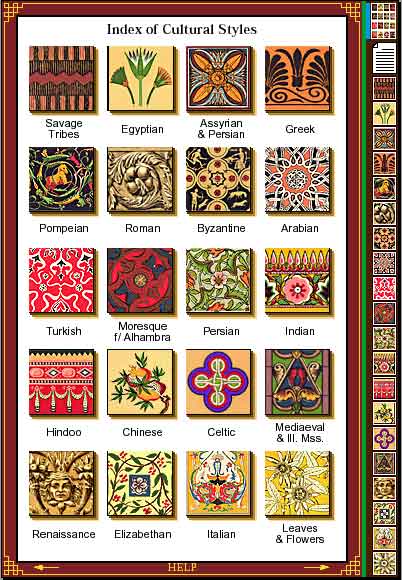 Many of you may be familiar with a large coffee table book called The Grammar of Ornament by Owen Jones. First published in 1856, the Grammar was the first text book on ornamental design and design theory. It is a marvelous collection of designs that cover a vast range of cultures and history, from the Egyptians through modern time.
The original Folio edition has over 2,300 designs on 100 color plates. It was printed using Chromolithography. Direct Imagination (Pasadena, CA) has taken the book and reproduced it on CD ROM for use with computer graphics.
They have used Adobe’s Acrobat software to create a ‘click and choose’ format for the user, and Adobe’s Acrobat Reader is included on the CD ROM.
There are two versions of the CD ROM collection; a Compact version ($99.00) and a Professional version ($199.00). In both versions, you have access to 2100 copyright-free images and you can use a ‘click and choose’ approach to locate, view and read about the images.
Grammar of Ornament CD Pro
Many of you may be familiar with a large coffee table book called The Grammar of Ornament by Owen Jones. First published in 1856, the Grammar was the first text book on ornamental design and design theory. It is a marvelous collection of designs that cover a vast range of cultures and history, from the Egyptians through modern time.
The original Folio edition has over 2,300 designs on 100 color plates. It was printed using Chromolithography. Direct Imagination (Pasadena, CA) has taken the book and reproduced it on CD ROM for use with computer graphics.
They have used Adobe’s Acrobat software to create a ‘click and choose’ format for the user, and Adobe’s Acrobat Reader is included on the CD ROM.
There are two versions of the CD ROM collection; a Compact version ($99.00) and a Professional version ($199.00). In both versions, you have access to 2100 copyright-free images and you can use a ‘click and choose’ approach to locate, view and read about the images.